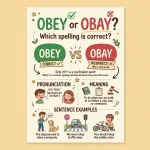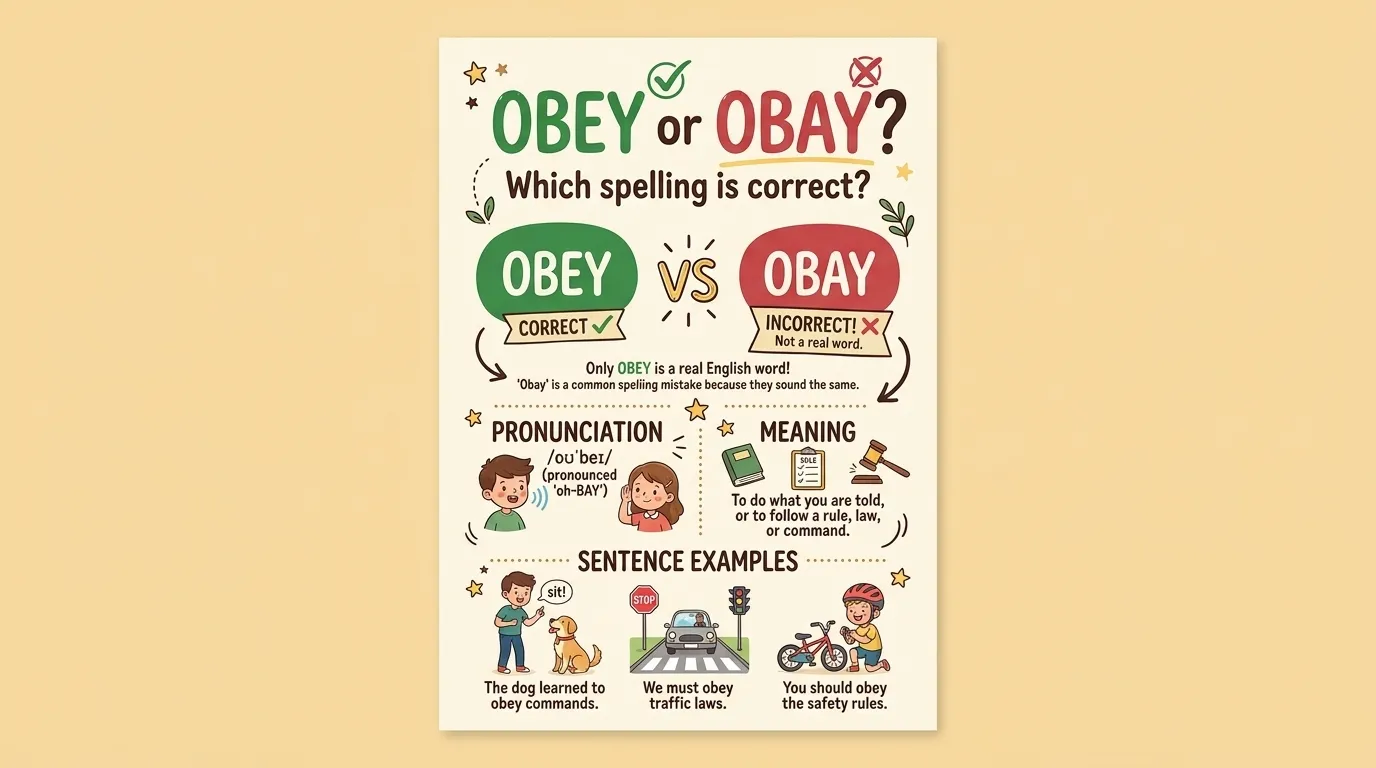
Obey is the correct English word. Obay is usually a spelling mistake.
Imagine a teacher asks a student to follow the classroom rules. The student listens and does what the teacher says. We say that the student obeys the teacher. Now, imagine someone writes, “I obay my parents.” The meaning is clear, but the spelling is wrong. The correct sentence is, “I obey my parents.”
The words obay or obey can confuse English learners because they sound similar. When people speak quickly, the difference may not be easy to notice. This is why many people search for the correct spelling online.
The word obey means to do what a person, rule, law, or order asks you to do. It is a common word in schools, homes, workplaces, and public life. The spelling obay is not the standard spelling of this word in modern English.
Learning the correct form helps you write better emails, school assignments, social media posts, and formal documents. It also helps you avoid spelling errors in exams and daily communication. In this guide, you will learn the meaning, pronunciation, history, usage, and common mistakes related to these two spellings.
Pronunciation
Both spellings may be read in a similar way when obay is intended to mean obey. However, obey is the standard English word.
| Word | US pronunciation | UK pronunciation |
| Obey | /oʊˈbeɪ/ | /əˈbeɪ/ |
| Obay | No standard pronunciation as an English word | No standard pronunciation as an English word |
Easy pronunciation guide:
- Obey: uh-BAY in many British accents; oh-BAY in many American accents.
- Obay: If used as a spelling error for obey, people will often intend the same sound.
The main point is that the correct spelling is obey.
Read more about:https://wordssense.com/nba-or-nfl/
Difference Between Obay and Obey
1. Correct Spelling
Obey is the correct spelling of the English verb. Obay is generally a misspelling when the writer means to follow an order or rule.
Examples:
- Correct: Children should obey their parents.
- Incorrect: Children should obay their parents.
2. Meaning
Obey means to do what someone tells you to do or to follow a rule. Obay has no standard meaning as an English word in this context.
Examples:
- We must obey the law.
- You should obey the safety rules.
3. Grammar
Obey is a verb. It describes an action. Obay does not serve as the standard spelling of this verb.
Examples:
- I obey my teacher.
- The workers obey the safety instructions.
4. Use in School
Students use obey when they talk about rules, instructions, or authority. Writing obay in schoolwork is a spelling error.
Examples:
- Students must obey school rules.
- Please obey your teacher’s instructions.
5. Use at Home
The word obey can describe following family rules or requests. The spelling obay should not be used for this meaning.
Examples:
- Children should obey their parents.
- He obeys his mother’s advice.
6. Use in the Workplace
Employees may need to obey workplace rules, safety instructions, and lawful orders. The correct spelling remains obey.
Examples:
- All staff must obey safety rules.
- Workers should obey the manager’s lawful instructions.
7. Use in Law
Laws and court orders may require people to act in certain ways. Writers use obey to describe following these requirements.
Examples:
- Every citizen must obey the law.
- The company must obey the court order.
8. Use in Formal Writing
Obey is suitable for essays, reports, letters, and official documents. Obay is not the standard form.
Examples:
- Drivers must obey traffic signals.
- The agency must obey the rules.
9. Use in Online Searches
People may type obay when they are unsure about the spelling. They may be looking for the word obey.
Examples:
- Search: “obay meaning.”
- Correct search: “obey meaning and examples.”
10. Use in Everyday Communication
The correct word helps readers understand your message without distraction. Using obay by mistake may make your writing look less careful.
Examples:
- Please obey the signs.
- We should obey the rules of the game.
Nature and Behaviour of Obay and Obey
Nature of Obey
Obey is a regular English verb. It describes the act of following a command, rule, law, or instruction. It can be used in different tenses.
Examples:
- I obey the rules.
- She obeyed the order.
- They will obey the law.
The word can describe willing action or action taken because of pressure. Its meaning depends on the situation.
Nature of Obay
Obay is not the standard spelling of the verb obey. When someone writes it by mistake, the reader may understand the intended meaning, but the spelling still needs correction.
Examples:
- Incorrect: Please obay the rules.
- Correct: Please obey the rules.
Why People Get Confused About Obay and Obey
People often confuse these spellings because they sound alike. English spelling does not always match pronunciation. The letter combination ey can represent the long “a” sound, as in they and obey.
Learners may also guess the spelling from the sound they hear. If they have not seen the word in print, they may write obay instead.
Typing quickly can cause the same problem. A person may know the word’s meaning but still choose the wrong letters. Search engines may also show results for misspelled searches, which can make the error seem more common than it is.
The easiest way to avoid this mistake is to remember the final two letters: ob-EY. Use obey whenever you mean to follow a rule, command, or instruction.
Comparison Table
| Feature | Obay | Obey |
| Standard English spelling | No, not for this meaning | Yes |
| Meaning | No standard meaning as this verb | To follow an order or rule |
| Part of speech | Not the standard verb form | Verb |
| Pronunciation | Depends on intended use | /oʊˈbeɪ/ US; /əˈbeɪ/ UK |
| Use in schoolwork | Incorrect for this meaning | Correct |
| Use in formal writing | Avoid | Appropriate |
| Use in emails | Correct it if intended as obey | Appropriate |
| Use in searches | May be a misspelled query | Correct search term |
| Similarity | Often intended to represent the same word | The correct form |
| Example | “Obay the law” is incorrect | “Obey the law” is correct |
The two spellings are similar in sound and appearance, but only obey is the standard spelling for this meaning.
The Origin of Obay or Obey
The word obey has a long history. It came into English through Old French obeir, which came from Latin oboedire. The Latin word meant to listen or pay attention to someone.
Over time, the meaning developed into following instructions, commands, or rules. Today, obey is used in many settings, including families, schools, workplaces, government, and law.
The spelling obay is usually a modern spelling error when someone intends to write obey. It is not the historical standard spelling of the English verb.
The history also helps explain the meaning. Obeying someone often involves listening first and then acting according to what was said. However, obeying does not always mean agreeing with the instruction. A person may follow a rule without liking it.
British vs American English
There is no spelling difference between British and American English for the verb obey. Both use the same spelling.
The main difference is often pronunciation. Many American speakers pronounce the first syllable with an “oh” sound. Many British speakers use a sound closer to “uh.” Accents vary, so these are broad guides rather than strict rules.
Examples:
- American English: Drivers must obey traffic laws.
- British English: Drivers must obey traffic laws.
Both sentences use the correct spelling. Neither variety uses obay as the standard spelling of this verb.
The same rule applies in other English-speaking countries, including Canada, Australia, and New Zealand. In formal writing, use obey regardless of the variety of English you follow.
Which One Should You Use?
Use obey in the United States, the United Kingdom, and other English-speaking countries. It is the correct spelling when you mean to follow a rule, order, or instruction.
For schoolwork, use obey in sentences about parents, teachers, laws, and classroom rules. For work emails, use it when talking about safety rules or official instructions. In formal reports, use it when the meaning fits.
If you see obay in a message, check the context. The writer may have intended to write obey. Correct the spelling when editing your own work.
For global English, the rule is simple: write obey, not obay, when you mean to follow instructions.
Common Mistakes
Here are common errors and their corrections.
| Incorrect sentence | Correct sentence |
| I obay my parents. | I obey my parents. |
| Please obay the rules. | Please obey the rules. |
| He obays his teacher. | He obeys his teacher. |
| They obayed the order. | They obeyed the order. |
| We must obay the law. | We must obey the law. |
| She will obay the instructions. | She will obey the instructions. |
| The driver did not obay the signal. | The driver did not obey the signal. |
Remember these forms:
- Present: obey
- He, she, or it: obeys
- Past: obeyed
- Present participle: obeying
Do not write obays, obayed, or obaying when you mean the standard verb forms.
Everyday Usage Examples
In Emails
You may use obey in a polite workplace or school email.
Example:
“Dear Team, please obey all safety rules while using the equipment. Thank you for your cooperation.”
On Social Media
People may use the word when discussing rules, respect, or personal choices.
Examples:
- “We should obey traffic rules to keep everyone safe.”
- “Respect matters, but obeying every demand is not always the same as doing what is right.”
In News
News reports may use obey when describing laws, court orders, or official instructions.
Examples:
- “Drivers were told to obey the new traffic rules.”
- “The court ordered the company to obey the law.”
These are sample sentences, not quotations from actual news reports.
In Formal Writing
The word is useful in essays, reports, and official documents.
Examples:
- “All employees must obey the safety policy.”
- “Citizens are expected to obey lawful instructions.”
In each case, obey is the correct spelling.
Usage Trends
Obey is an established English word used around the world. It appears in education, law, public safety, family life, workplace policies, books, and online discussions.
People may search for obay because they are unsure how to spell the word. A misspelled search does not mean that the spelling is accepted English. Search results can include corrections, user-generated text, names, or unrelated content.
Without a specific search-data source, it would not be accurate to give exact figures for how often people use either spelling. The practical lesson is clear: use obey in published writing, school assignments, websites, and professional communication.
If you run an English-learning website, an article on “obay or obey” can help readers who want a quick spelling answer. Explain the error clearly and include simple examples.
Metaphors and Similes
Obey can also appear in figurative language. In these examples, it describes how something responds to a force, rule, or condition.
Metaphors
A metaphor describes one thing as another.
- “The machine obeys every command.” This means the machine responds as instructed.
- “The river obeys no road.” This suggests that the river follows its natural path rather than human plans.
Similes
A simile compares things using words such as like or as.
- “He followed the coach’s instructions like a soldier obeying orders.”
- “The robot moved as if it could obey every thought.”
These examples use obey in a wider sense. They do not change its spelling or basic meaning.
Connotative Meaning
The word obey can carry different feelings depending on the situation.
Positive Meaning
Obeying can suggest care, safety, respect, or responsibility.
Examples:
- “The child obeyed the road safety rules.”
- “The workers obeyed the emergency instructions.”
Here, obeying helps protect people.
Negative Meaning
The word can suggest control or a lack of freedom when a person is forced to follow unfair demands.
Examples:
- “The ruler expected everyone to obey without question.”
- “She felt forced to obey an unfair order.”
Here, the word may create a sense of pressure.
Neutral Meaning
Sometimes obey simply describes an action without praise or blame.
Examples:
- “The computer obeys the user’s command.”
- “The dog obeyed the hand signal.”
The situation determines whether the word sounds positive, negative, or neutral.
Idioms and Proverbs
There are several common expressions related to obedience, rules, and authority. They help explain the idea, though they are not direct replacements for obey.
Follow the Rules
Meaning: Act according to the rules.
Example: “Everyone must follow the rules during the exam.”
Do as You Are Told
Meaning: Follow someone’s instructions.
Example: “The coach asked the players to do as they were told during the drill.”
Toe the Line
Meaning: Follow the rules or accept the demands of a group or authority.
Example: “The staff were expected to toe the line at work.”
Rules Are Rules
Meaning: Rules are expected to be followed, even when someone does not like them.
Example: “You cannot enter without a ticket. Rules are rules.”
Better Safe Than Sorry
Meaning: It is wiser to take care than to risk harm.
Example: “Obey the warning sign. Better safe than sorry.”
These expressions show that obedience can relate to safety, duty, group expectations, or authority.
Literature and Movies
Obedience is a common theme in books and films. Writers often explore the difference between following orders and making personal choices.
Literature
1. The Adventures of Pinocchio — Carlo Collodi, 1883
This Italian children’s novel follows Pinocchio as he learns about honesty, responsibility, and the results of his choices. His experiences include lessons about listening to good advice.
2. Animal Farm — George Orwell, 1945
This political satire explores power, control, and the use of rules. It shows how leaders can demand obedience and how authority can be misused.
3. The Giver — Lois Lowry, 1993
This young adult dystopian novel presents a society with strict rules. It asks readers to think about the value of personal choice and unquestioned obedience.
Movies
1. Pinocchio — United States, 1940
This animated film follows a wooden puppet who learns lessons about honesty and responsibility.
2. Dead Poets Society — United States, 1989
This drama explores school rules, family pressure, and independent thought. It shows the tension between authority and personal choice.
3. The Hunger Games — United States, 2012
This science-fiction adventure portrays a powerful government that expects people to follow its demands. The story explores control, resistance, and courage.
These works do not all use the exact word obey as their central theme. They are useful examples of stories that explore obedience, authority, and choice.
Why This Difference Matters
Knowing the difference between obay and obey may seem like a small detail, but correct spelling makes writing clearer.
For English learners, spelling practice builds confidence. A student who knows the correct form can write better exam answers and avoid repeated errors. Teachers can also use this word to teach verbs and their forms, such as obeys, obeyed, and obeying.
For website owners and content writers, correct spelling helps create useful and professional content. A spelling mistake in a heading can distract readers and reduce trust. Search engines may still understand a misspelled word, but that is not a reason to publish the error.
The difference also matters when people discuss rules and authority. The word obey can describe a helpful action, such as following a safety rule, or a difficult situation, such as being forced to follow an unfair order.
The best approach is to spell the word correctly and explain its meaning in context.
Usefulness in Daily Life
The word obey is useful in many daily situations.
- At home: “Children should obey reasonable family rules.”
- At school: “Students must obey the exam instructions.”
- On the road: “Drivers must obey traffic signals.”
- At work: “Staff must obey safety procedures.”
- In public places: “Visitors should obey warning signs.”
- With technology: “The device will obey the command.”
- In writing: “Always obey the required word limit.”
Learning this word also helps you understand signs, school books, news reports, and workplace documents.
However, obeying does not mean that every order is right. In real life, people should consider safety, law, and fairness. If an instruction seems dangerous or unlawful, seek proper guidance rather than following it blindly.
For spelling, there is no such doubt: obey is the standard form.
Situational Preference
Use obey in every situation where you mean to follow an instruction, rule, law, or command. It is suitable for casual conversation, school assignments, formal letters, workplace emails, and news writing. In American and British English, the spelling stays the same. Avoid obay unless you are discussing that exact spelling as an error, quoting text, or referring to a specific name that uses it. If you are teaching beginners, give them a simple example such as “Obey the rules.” Then show the forms obeys, obeyed, and obeying. This makes the spelling easier to remember.
Possible asked questions
1. Is obay or obey correct?
Obey is correct when you mean to follow a rule, order, or instruction. Obay is generally a spelling mistake for this meaning.
2. What does obey mean?
Obey means to do what a person tells you to do or to follow a rule or law.
Example: “Drivers must obey traffic laws.”
3. How do you pronounce obey?
In many American accents, it sounds like “oh-BAY.” In many British accents, it sounds like “uh-BAY.” Pronunciation varies by region.
4. Is obay a real English word?
It is not the standard spelling of the verb meaning “to follow instructions.” It may appear as a name or in other special contexts, but ordinary English writing should use obey.
5. What is the past tense of obey?
The past tense is obeyed.
Example: “She obeyed the teacher’s instructions.”
6. What is the difference between obey and obeys?
Use obey with I, you, we, and they. Use obeys with he, she, and it in the simple present tense.
Examples:
- They obey the rules.
- He obeys the rules.
7. Is obey spelled the same in British and American English?
Yes. Both British and American English use obey. There is no standard spelling difference.
Conclusion
The difference between obay or obey is simple. Obey is the correct English spelling when you mean to follow a rule, order, command, or instruction. Obay is usually a spelling mistake in this context.
The word obey is used in many parts of daily life. Children may obey their parents, students may obey school rules, and drivers must obey traffic laws. Workers may also need to obey safety instructions. The word can describe a good action, a neutral response, or a situation where someone feels controlled. Its meaning depends on the context.
British and American English use the same spelling, although pronunciation can vary. The word also has a long history, coming into English through Old French from Latin. Learning its history and examples can help you remember it.
If you are learning English, focus on the correct spelling and verb forms: obey, obeys, obeyed, and obeying. Use these forms in emails, essays, reports, and online posts. When you see obay, check whether the writer intended obey.
Remember this easy rule: You obey rules; you do not obay them. Correct spelling makes your English clearer and more professional.

I’m Zahid Abbas, an educator, researcher, and digital publishing strategist with a passion for linguistics, grammar, and clear communication. As a content creator and SEO specialist, I craft research-driven, reader-focused content that empowers learners and makes knowledge accessible worldwide.