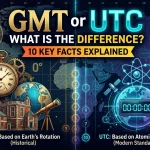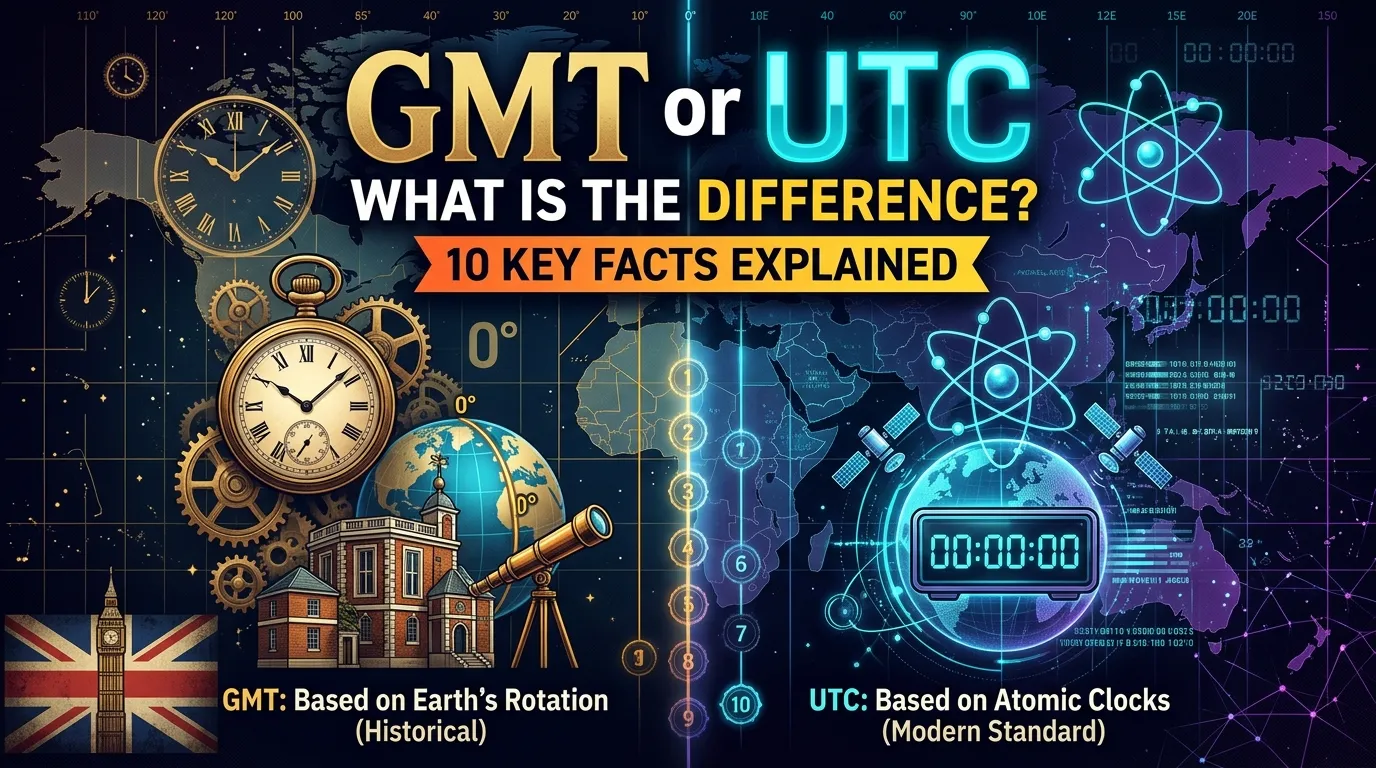
GMT and UTC are almost the same for everyday timekeeping, but they are not the same thing.
Imagine you are in Pakistan and need to join an online meeting with someone in London. The meeting time is 10:00 GMT. Another website shows 10:00 UTC. You may wonder if these times are different. In everyday use, they usually match. Both use the same zero-hour offset as the main reference for world time.
GMT stands for Greenwich Mean Time. UTC stands for Coordinated Universal Time. GMT is linked to the mean solar time at Greenwich, London. UTC is the global time standard used to keep clocks and systems in sync.
People search for GMT or UTC because they see both terms in emails, flight schedules, news reports, computer settings, and online events. They want to know which time is correct and whether they need to add or subtract hours.
The key point is simple: GMT is a time zone and time reference, while UTC is the main international time standard. Their displayed times are the same for most everyday purposes. Knowing the difference helps you plan meetings, read schedules, and avoid time mistakes.
Pronunciation of GMT and UTC
| Term | US pronunciation | UK pronunciation |
| GMT | Jee-em-tee | Jee-em-tee |
| UTC | You-tee-see | You-tee-see |
Both abbreviations are usually spoken one letter at a time.
Transition: Now, let us look at the key differences, how each term works, and when to use them.
Read more about:https://wordssense.com/nba-or-nfl/
Difference Between GMT and UTC
The main difference is that UTC is an international time standard, while GMT is commonly used as a time zone. Both show the same clock time in ordinary use. However, their meanings and technical uses can differ.
1. Full Forms
GMT and UTC have different full forms.
- GMT: Greenwich Mean Time
- UTC: Coordinated Universal Time
GMT takes its name from Greenwich in London. UTC has a name chosen for international use.
Examples:
- The train schedule lists the time in GMT.
- The computer stores the event time in UTC.
2. Main Purpose
GMT is often used to name a time zone. UTC provides a common time standard for the world.
Examples:
- The UK uses GMT during winter.
- A website may use UTC to record when a user signs in.
3. How They Measure Time
GMT has historical links to the average movement of the Sun at Greenwich. UTC uses highly accurate atomic clocks and leap-second adjustments to stay close to Earth’s rotation.
Examples:
- GMT has a long history in astronomy and navigation.
- UTC helps computers record exact event times.
4. Clock Time
GMT and UTC usually display the same hour and minute.
Examples:
- 09:00 GMT is normally 09:00 UTC.
- 18:30 UTC is normally 18:30 GMT.
For everyday scheduling, you usually do not need to convert one into the other.
5. Time Offset
Both GMT and UTC have a zero-hour offset from the global reference meridian.
Examples:
- 12:00 UTC is written as UTC+0.
- 08:00 GMT is written as GMT+0.
Remember that local time zones may have different offsets.
6. Daylight Saving Time
UTC never changes for daylight saving time. GMT itself remains at UTC+0, but the UK moves to British Summer Time (BST), which is UTC+1.
Examples:
- London uses GMT during winter.
- London uses BST during summer.
Do not assume that London always follows GMT.
7. Scientific Use
UTC is preferred when an exact, shared time reference is needed. GMT may appear in older scientific records or in less technical descriptions.
Examples:
- A satellite system may use UTC for time records.
- An old astronomy book may mention GMT.
8. Computer and Internet Use
UTC is widely used in computer systems, databases, and online services because it gives users around the world a common reference.
Examples:
- A server saves a login time as 14:00 UTC.
- A global website lists a live event at 14:00 UTC.
GMT may also appear in website settings and online schedules.
9. Writing the Time
UTC is commonly written using the 24-hour clock in technical and international communication. GMT may appear with either the 12-hour or 24-hour clock in everyday writing.
Examples:
- The report states 19:00 UTC.
- The notice says 7:00 PM GMT.
For clarity, use the 24-hour format when sharing times across countries.
10. Best Choice for Global Communication
UTC is generally the clearer choice for technical work and international coordination. GMT remains familiar in British timekeeping and everyday conversation.
Examples:
- A global software team schedules a meeting for 15:00 UTC.
- A UK winter event is advertised for 3:00 PM GMT.
The best term depends on the setting and the level of precision required.
Nature and Behaviour of GMT and UTC
Nature of GMT
GMT is a traditional time reference linked to Greenwich, England. Today, it is also used as the name of a time zone with a zero-hour offset.
Its main features are:
- It is closely linked to British timekeeping.
- It is used in winter in the UK.
- It is often used in everyday schedules.
- It has a long history in navigation and astronomy.
GMT does not change to summer time. The UK changes to BST instead.
Nature of UTC
UTC is the internationally agreed time standard. It is based on atomic time and adjusted with leap seconds to keep it close to Earth’s rotation.
Its main features are:
- It gives the world a shared time reference.
- It supports computer and network systems.
- It helps people compare times across time zones.
- It stays unchanged when countries change their clocks for summer.
UTC is useful because it gives people a common starting point for time calculations.
Why People Get Confused About GMT and UTC
People often get confused because GMT and UTC usually show the same time. If both clocks display 10:00, it may seem that the terms mean exactly the same thing.
There are several reasons for this confusion.
First, both have a zero-hour offset. This means neither is ahead of or behind UTC in ordinary time-zone use.
Second, people use the terms in similar ways. A news report, website, or meeting invitation may use GMT when UTC would be more suitable.
Third, the history is complex. GMT was once a major international time reference. UTC later became the standard for modern global timekeeping.
Fourth, daylight saving time adds confusion. The UK uses GMT in winter and BST in summer. UTC does not change.
For example, 12:00 UTC and 12:00 GMT usually refer to the same clock time. But 12:00 in London during summer is 11:00 UTC.
The simple rule is to use UTC for global and technical communication. Use GMT when you mean the GMT time zone or when the context calls for it.
Comparison Table
| Feature | GMT | UTC |
| Full form | Greenwich Mean Time | Coordinated Universal Time |
| Main role | Time zone and traditional time reference | International time standard |
| Usual offset | UTC+0 | UTC+0 |
| Displayed time | Same as UTC in ordinary use | Same as GMT in ordinary use |
| Daylight saving | GMT stays at UTC+0 | UTC never changes for daylight saving |
| Summer in the UK | BST replaces GMT | Remains unchanged |
| Technical systems | Used in some settings | Widely preferred |
| Global meetings | Acceptable when clear | Commonly recommended |
| 24-hour clock | 12-hour or 24-hour format | 24-hour format is common |
| History | Older time reference | Modern international standard |
Similarities
GMT and UTC share several features:
- Both use the zero-hour reference.
- Both help people compare time across countries.
- Both are used in news, travel, and online schedules.
- Both can describe the same hour and minute.
- Both help reduce confusion when people work across time zones.
Main Usage Difference
Choose UTC for precise records, computer systems, and global events. Choose GMT when referring to the GMT time zone, especially in winter-time UK contexts.
The Origin of GMT and UTC
The History of GMT
Before standard time became common, towns often set their clocks using local solar time. This caused problems for railway travel and communication because each town could have a different time.
Greenwich became important because of its Royal Observatory and its work in astronomy and navigation. GMT spread through Britain during the 19th century. It became the legal time of Great Britain in 1880 and gained international importance during the 1884 International Meridian Conference.
Greenwich became a key reference point for maps, navigation, and world time zones.
The History of UTC
Modern timekeeping needed a more stable standard than one based only on Earth’s rotation. Atomic clocks made it possible to measure time with great accuracy.
UTC was developed as an international standard in the 20th century and became the basis for modern civil timekeeping. Its name was selected to work across languages rather than favoring the English abbreviation CUT or the French abbreviation TUC.
UTC now supports many systems, including communications, navigation, science, and computing.
Why the Difference Still Matters
GMT is an important part of timekeeping history and remains in everyday use. UTC is the standard that helps modern systems keep time in a consistent way.
The two terms often give the same clock reading, but they serve different roles.
British vs American English
GMT and UTC are used in both British and American English. Neither term has a different spelling in the two varieties.
Spelling and Meaning
Both countries use the same abbreviations:
- British English: GMT and UTC
- American English: GMT and UTC
The full forms are also the same. The main difference is not spelling. It is how people use time zones in daily life.
British English Examples
The UK uses GMT during winter and British Summer Time during summer.
- The train leaves at 10:00 GMT in winter.
- The online meeting starts at 14:00 UTC.
American English Examples
The United States has several time zones. People often convert UTC to local time before planning a meeting.
- The webinar starts at 15:00 UTC.
- The meeting starts at 10:00 AM Eastern Daylight Time.
The second example uses a US local time zone, not GMT.
Main Rule
British and American English follow the same basic rules for GMT and UTC. Always check whether a schedule gives a global reference time or a local time.
Which One Should You Use?
Your choice depends on your purpose.
- For US users: Use UTC for technical records and global events. Use local time zones, such as Eastern Time or Pacific Time, for everyday plans.
- For UK users: Use GMT during winter when referring to the local time zone. Use BST during summer. UTC works throughout the year as a stable reference.
- For global users: Use UTC for online meetings, software, international schedules, and shared records.
For example, if you invite people from Pakistan, the UK, and the US to one meeting, write “15:00 UTC” and provide local times when useful.
This reduces confusion because each person can convert the same reference time to their local clock.
Common Mistakes
Here are common errors people make when using GMT and UTC.
Mistake 1: Saying GMT and UTC Are Exactly the Same
Incorrect: GMT and UTC have the same meaning in every situation.
Correct: They usually show the same clock time, but they have different roles.
Mistake 2: Changing UTC for Summer Time
Incorrect: Add one hour to UTC when summer starts in the UK.
Correct: UTC stays unchanged. The UK changes from GMT to BST.
Mistake 3: Thinking GMT Is Always UK Local Time
Incorrect: London always follows GMT.
Correct: London uses BST during summer, which is UTC+1.
Mistake 4: Forgetting the Local Offset
Incorrect: A 12:00 UTC meeting must start at 12:00 in every country.
Correct: Each country converts UTC to its local time.
For example, 12:00 UTC is 17:00 in Pakistan, which uses UTC+5.
Mistake 5: Mixing Up UTC and Local Time
Incorrect: Writing “10:00 local time” when inviting a global team without naming the location.
Correct: Write “10:00 UTC” or clearly name the local time zone.
Mistake 6: Using AM and PM Without Clear Context
Incorrect: Writing “7:00 UTC PM.”
Correct: Write “19:00 UTC.”
The 24-hour format is clear and widely used in technical settings.
Everyday Usage Examples
GMT and UTC appear in daily communication, travel, news, and technology.
In Emails
A clear email helps people in different countries plan the same event.
Example:
Subject: Online Meeting
Our meeting will begin at 14:00 UTC on Friday. Please convert this time to your local time zone.
On Social Media
News accounts and event organizers may use UTC to share a common time.
Examples:
- “The live stream starts at 18:00 UTC.”
- “The online event begins at 12:00 GMT.”
Always check the date and time zone before joining.
In News Reports
News reports may use GMT or UTC when describing events across countries.
Examples:
- “The press conference begins at 09:00 GMT.”
- “The report was published at 16:30 UTC.”
The exact format depends on the news source and its audience.
In Formal Writing
Formal writing should use a clear, consistent time format.
Examples:
- “All submissions must arrive by 23:59 UTC.”
- “The interview will take place at 10:00 GMT during the UK winter.”
For international work, UTC often avoids confusion.
In Computer Systems
Computer systems may record events in UTC so that records from different countries can be compared.
Examples:
- “User login recorded at 08:45 UTC.”
- “The system update begins at 02:00 UTC.”
This is useful for websites, servers, and online services.
Usage Trends
GMT remains widely recognized because of its long history and its connection to Greenwich. It is also used in UK winter timekeeping and in many everyday schedules.
UTC is widely used in technical fields, including computing, telecommunications, science, aviation, and international coordination. It provides a common reference for systems around the world.
The terms can appear together because their practical clock readings usually match.
For example, a general reader may search for “GMT time now,” while a software developer may work with UTC timestamps. Both are looking for a reliable time reference, but their needs are different.
There is no need to avoid GMT in everyday writing. However, UTC is often the clearer choice when a time must be shared across many countries or recorded by a computer system.
Metaphors and Similes
GMT and UTC are technical terms, so they do not have common figurative meanings of their own. However, writers can use metaphors and similes to explain how they work.
Metaphors
1. UTC is the world’s shared clock.
This means UTC gives people a common starting point for time.
Example: “UTC is the world’s shared clock for our online team.”
2. GMT is a bridge to the past.
This refers to GMT’s long history in navigation and timekeeping.
Example: “GMT is a bridge to the past, linking modern schedules to Greenwich’s history.”
3. UTC is a common meeting point.
This means people can use UTC to agree on one time.
Example: “UTC became our common meeting point for the global project.”
Similes
1. UTC is like a master clock.
Example: “UTC is like a master clock that helps our systems stay in sync.”
2. GMT and UTC are like two labels on the same clock.
Example: “For everyday scheduling, GMT and UTC are like two labels on the same clock.”
These figures of speech help beginners understand the ideas without changing their technical meanings.
Connotative Meaning
Connotation is the feeling or idea that a word brings to mind. GMT and UTC are neutral technical terms, but people may connect them with different ideas.
Positive Associations
GMT may suggest history, tradition, and Greenwich’s role in navigation.
Example: “The GMT reference reminds us of the history of world timekeeping.”
UTC may suggest accuracy, order, and global teamwork.
Example: “Our team uses UTC to keep every meeting clear.”
Negative Associations
Neither term has a naturally negative meaning. However, people may connect them with confusion when a schedule does not explain the time zone.
Example: “The event notice caused confusion because it listed GMT without explaining the local time.”
Another example:
“The team missed the meeting because members misunderstood the UTC conversion.”
Neutral Meaning
Both terms mainly describe time references.
Examples:
- “The report lists its release time in UTC.”
- “The notice gives the departure time in GMT.”
In most situations, the words are factual rather than emotional.
Idioms and Proverbs
There are no widely recognized idioms or proverbs that specifically depend on GMT or UTC. However, common expressions about time can help explain their practical value.
Against the Clock
Meaning: Working quickly because time is limited.
Example: “The team worked against the clock to finish the project before 18:00 UTC.”
In the Nick of Time
Meaning: Just before it is too late.
Example: “She submitted the form in the nick of time, one minute before the UTC deadline.”
Time Is Money
Meaning: Time is valuable, so use it well.
Example: “Clear UTC schedules save time for businesses working across countries.”
Better Late Than Never
Meaning: Doing something late is better than not doing it at all.
Example: “The team sent the corrected GMT meeting notice late, but better late than never.”
These expressions relate to time in general. They are not special GMT or UTC idioms.
Literature and Movies
GMT and UTC are mainly technical terms. They are not common themes or characters in literature and films. However, timekeeping, clocks, and time zones often appear in stories about travel, science, and human life.
Literature
Around the World in Eighty Days
Writer: Jules Verne | Year: 1873 | Genre: Adventure
This novel follows a journey around the world. Travel schedules and differences in local time are relevant to its story. It helps readers see why keeping track of time matters when crossing countries.
Longitude
Writer: Dava Sobel | Year: 1995 | Genre: History and science
This book explains the problem of finding longitude at sea and the role of accurate clocks in navigation. It provides useful background on the history of timekeeping.
Movies
Around the World in 80 Days
Year: 1956 | Country: United States | Genre: Adventure
The film follows a race around the world. Its travel theme shows why planning, deadlines, and time differences can matter.
Interstellar:Year: 2014 | Country: United States and United Kingdom | Genre: Science fiction
This film explores time, space, and the effects of relativity. It does not focus on GMT versus UTC, but it shows how complex the idea of time can become.
These books and films offer context about travel and time. They should not be taken as direct explanations of the technical difference between GMT and UTC.
Why This Difference Matters
Understanding GMT and UTC helps people communicate clearly. A small time mistake can cause a missed meeting, a late submission, or a travel problem.
For English learners, this topic also builds useful vocabulary. It teaches the difference between a time zone and a time standard.
For students, it helps when reading science books, news reports, and international schedules.
For businesses, it makes global meetings easier to arrange. Teams can choose one reference time and convert it to local times.
For society, a shared time standard supports communication, transport, research, and digital services.
Consider a company with staff in Pakistan, London, and New York. If the company says only “meet at 3:00,” each person may understand a different local time. If it says “meet at 10:00 UTC,” everyone has the same starting point.
The main lesson is simple: GMT and UTC usually show the same time, but UTC is the clearer standard for precise global communication.
Usefulness in Daily Life
Knowing the difference between GMT and UTC is useful in many common situations.
- Online meetings: Use UTC to set one clear time for people in different countries.
- Travel: Check whether a flight or train schedule uses local time or a global reference.
- School and study: Read international exam schedules and online class times correctly.
- News: Understand when an event happened, even if the report comes from another country.
- Websites: Read timestamps and event notices without guessing the time zone.
- Gaming: Join global tournaments at the correct time.
- Work: Set deadlines that people in different regions can understand.
- Science: Read reports that need a common time reference.
For example, if an online class starts at 09:00 UTC, a person in Pakistan should add five hours. The class starts at 14:00 Pakistan Standard Time.
This simple conversion can prevent many mistakes.
Situational Preference
The best choice depends on the situation. For a technical report, computer log, or international meeting, UTC is usually the clearest option. It provides one stable reference throughout the year. For a British winter schedule, GMT is also suitable because it names the local time zone. In summer, use BST when you mean the UK’s local clock time. In the United States, local time zones such as Eastern Time or Pacific Time may be more helpful for everyday events. For a global audience, give the UTC time and add local conversions if needed. Always include the date, especially when people live in different time zones.
Possible asked questions
1. Are GMT and UTC the same?
They usually show the same clock time. However, GMT is a time zone and traditional time reference, while UTC is the international time standard.
2. Which is better, GMT or UTC?
Neither is better for every situation. UTC is usually preferred for technical records and global communication. GMT is useful when referring to the GMT time zone.
3. Is GMT always the same as UTC?
For ordinary timekeeping, GMT is at UTC+0, so the displayed times match. In precise astronomical contexts, the terms can refer to different time scales.
4. Does UTC change during daylight saving time?
No. UTC stays unchanged. Countries that use daylight saving time change their local clocks instead.
5. Is the UK on GMT or UTC?
The UK uses GMT during winter and British Summer Time (BST) during summer. UTC remains unchanged throughout the year.
6. What is the difference between GMT and UTC in Pakistan?
Both GMT and UTC are five hours behind Pakistan Standard Time. For example, 10:00 UTC is 15:00 in Pakistan. Pakistan uses UTC+5 throughout the year.
7. Should I write GMT or UTC in an email?
Use UTC for international meetings and technical schedules. Use GMT when the context specifically refers to the GMT time zone. Always include the date and use a clear time format.
Conclusion
GMT and UTC are two important terms in world timekeeping. They often show the same clock time, but they have different meanings. GMT stands for Greenwich Mean Time. It has a long history linked to Greenwich, England, and is still used as a time zone. UTC stands for Coordinated Universal Time. It is the international time standard used for accurate and shared timekeeping.
The key difference is their role. GMT is commonly used to describe a time zone, while UTC gives people and systems a common reference for time. UTC does not change when countries start or end daylight saving time. GMT also stays at UTC+0, but the UK switches to British Summer Time during summer.
If you plan an online meeting, manage a website, read international news, or work with people in other countries, UTC is usually the clearest choice. If you are talking about British winter time, GMT is appropriate.
Remember one simple rule: GMT and UTC usually have the same clock reading, but UTC is the standard for precise global timekeeping. Once you understand this difference, you can read schedules, convert times, and communicate with people around the world with greater confidence.

I’m Zahid Abbas, an educator, researcher, and digital publishing strategist with a passion for linguistics, grammar, and clear communication. As a content creator and SEO specialist, I craft research-driven, reader-focused content that empowers learners and makes knowledge accessible worldwide.